In the Train Room of the Tuolumne Memorial Museum, a working model of the West Side narrow-gauge logging railroad runs through a model of the mill it was built to feed. Next to it are wooden molds from the Tuolumne Foundry that were used to cast parts for the train engines and the lumber mill. In the next room hangs a wall-size mural of the West Side log pond, along with a video of logs being dumped from a train into that pond.
That model is the smallest version of something Tuolumne still has in full. The same railroad shows up again a few blocks away as a full-size locomotive and again a mile east of downtown as the actual rail bed, cut into the wall of the Tuolumne River canyon. A short drive along Carter Street takes you past all three, and the model shows you the whole line before you set foot on any of it.
The Model on Carter Street
The museum sits at 18663 Carter Street, on the corner of Carter and Bay. The building opened in 1922 as the Tuolumne Women's Improvement Club clubhouse. It held the town's library and kindergarten classes before the club deeded it to the museum in 1981, and the museum opened there in December 1984. Volunteers run it, and the posted hours are 1 to 4 p.m. on Saturdays and Sundays, most weekends. The Tuolumne County Historical Society lists admission as free.
The model is the best place to start because it explains the scale of the operation. The Historical Society says the West Side Lumber Company held 60,000 acres of timber, with 75 miles of narrow-gauge railroad and 250 miles of spur track running into the forest. In town, the company built a large sawmill, drying sheds, storage yards and a box factory. It also supplied the town's electricity and built company homes for its workers. The company started on land rancher Frank Baker sold it along Turnback Creek and began operating in 1899. The Sierra Railway reached the town, then called Carters, on February 1, 1900, and named its station "Tuolumne." Nine years later, in 1909, the town officially took that name.
There's a West Side connection right outside the museum, too. In the Family Gallery are instruments that belonged to Dr. Reid, the West Side's physician. Reid Park, on the southeast corner of the same intersection, is where his three-story hospital stood. A block over, the Ellis Home at 18461 Bay Street was built by the company in 1898 for its superintendent's family. The Historical Society calls it the town's best example of the transition from Queen Anne to Colonial Revival style. It's a private residence today, so it's a house to admire from the sidewalk.
The Engine in West Side Memorial Park
The second stop is full size. Heisler Locomotive No. 2 was built in 1899. It ran on the Hetch Hetchy and Yosemite Valley Railroad and spent most of its working life as a switcher at the West Side mill. A passenger depot once stood next to it, and the Historical Society points out that the rails are still in the ground. The Union Democrat describes the engine as sitting in West Side Memorial Park as a tribute to the town's logging history. The same paper reports that the mill's sawdust burner still stands at the edge of the former mill pond.
None of the West Side's bigger engines are still in town. After the West Side Lumber Company shut down in 1961, seven of its Shay locomotives sat at the mill: Nos. 7, 8, 9, 10, 12, 14 and 15. A February 1965 photo in the Tuolumne Historical Railroad Association's newsletter, The Journey, shows them lined up there. The association says all seven are preserved, though none of them in Tuolumne, and that "the mill, the pond, and the Shays are long gone." Two of them, Shays 10 and 15, still run on the Yosemite Mountain Sugar Pine Railroad at Fish Camp. To see West Side equipment in Tuolumne itself, you go to the Heisler.
The Grade Itself
The third stop is the railroad's actual route. The Stanislaus National Forest calls it the West Side Railroad Grade. Its trailhead is at the Miramonte subdivision, about a mile east of downtown. According to the Forest Service's printed guide, you take Carter Street to Buchanan Road, turn right, and go 0.2 mile to the parking area on the left at Buchanan and Mira Monte roads. Visit Tuolumne adds that the first kiosk is down a set of stairs from the lot. The Tuolumne Park and Recreation District gives a second way in, from Carter Street to Old Buchanan Mine Road.
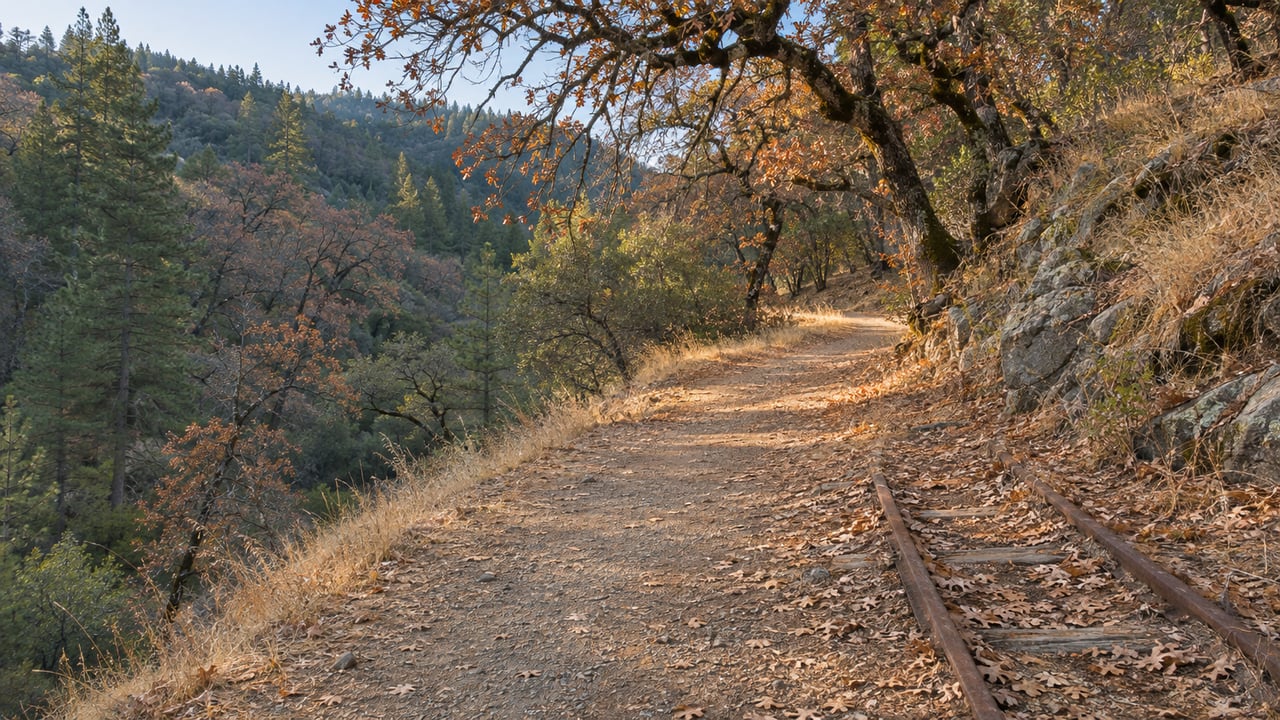
The Forest Service guide tells the canyon's history. Chinese workers started cutting the mainline grade between Carters and the North Fork of the Tuolumne River in 1901, and local Native Americans finished it. With no bulldozers or loaders, the crews carved the railway out of the canyon wall, following its turns and drainages until it crossed the North Fork. Today 5.5 miles of that grade are open to hikers, bikers and horseback riders. Along the way you'll see rails, ties and stacked-rock retaining walls. In 2012, several agencies put up interpretive panels along the route.
According to TrailLink, the trailhead has no sign, and trees line both sides of the path for the first half mile before it opens up to views of the canyon. A little past the first mile, the old rails and ties come back into view, and they continue most of the way to the river. The track the model runs on in the Train Room, and the rails still in the ground beside the Heisler, are the same narrow-gauge line you're walking along here. The Park and Recreation District puts a picnic table about a mile in, right around where the rails come back.
The trail surface is crushed stone and dirt. The Forest Service describes the trail as wide and level. TrailLink notes it gets narrow and rocky in places, and about 5 miles in, a thick stand of trees blocks the way along the rails. From there you can turn back, or take steep switchbacks about half a mile down to Fish Hatchery Road and on to River Ranch Campground, which charges a day-use fee. Most people walking from town just pick a turnaround point. The district's trail page says to walk or bike as far as you like.
Walking It in Late Fall and Winter
On its page for the grade, the Forest Service recommends the spring wildflowers but warns about "hot temperatures." Its printed guide says there's little or no shade on the trail and tells hikers to bring plenty of water, a hat and a snack. The same guide says the trail stays open through the winter except in extreme weather.
The Forest Service site was marked open on its last update, June 30, 2026. There's no drinking water past the parking area, and motor vehicles aren't allowed, including on the sections run by the Tuolumne Park and Recreation District and the BLM. Conditions can change through the winter, so check that page before you head out. Bring your own water, even in cold weather. Dogs are welcome on leash. Riders can use the equestrian parking at the trailhead.
Timing the Three Stops Around the Holidays
The museum is the only one of the three with set hours, so plan around it. It's closed on Thanksgiving weekend, November 28 and 29, and again December 26 and 27 and January 2 and 3. If you have family in town over Thanksgiving, show them the Heisler and the trail that weekend and come back for the Train Room on a December weekend. For a full afternoon, go to the museum when it opens at 1 p.m., stop at West Side Memorial Park on the way out, and finish at the Buchanan Road trailhead.
For more on the railroad, the Tuolumne Railroad Weekend runs April 16 to 18, 2027, at Black Oak Casino Hotel. Its main event is the West Side Reunion, a logging modelers convention, held Saturday, April 17, from 9 a.m. to 4:30 p.m. in the hotel's lower-level conference center. It's the full-scale gathering of people who build models like the one in the Train Room, held in the town whose railroad they're modeling.
You can find more about the town, from its new bike park to its downtown, on our Tuolumne City neighborhood page, and the story of the bike park is in The Saturdays That Built Tuolumne's New Bike Park.
Many of Tuolumne's older streets grew up around the West Side mill, including the company homes it built for its workers. If you own a home in that part of town and are curious what it's worth today, start with Mother Lode Real Estate and get your free instant home valuation.